Multilingual Scripture AI
4x increase in subscriptions after adding a verse-aware assistant in six languages
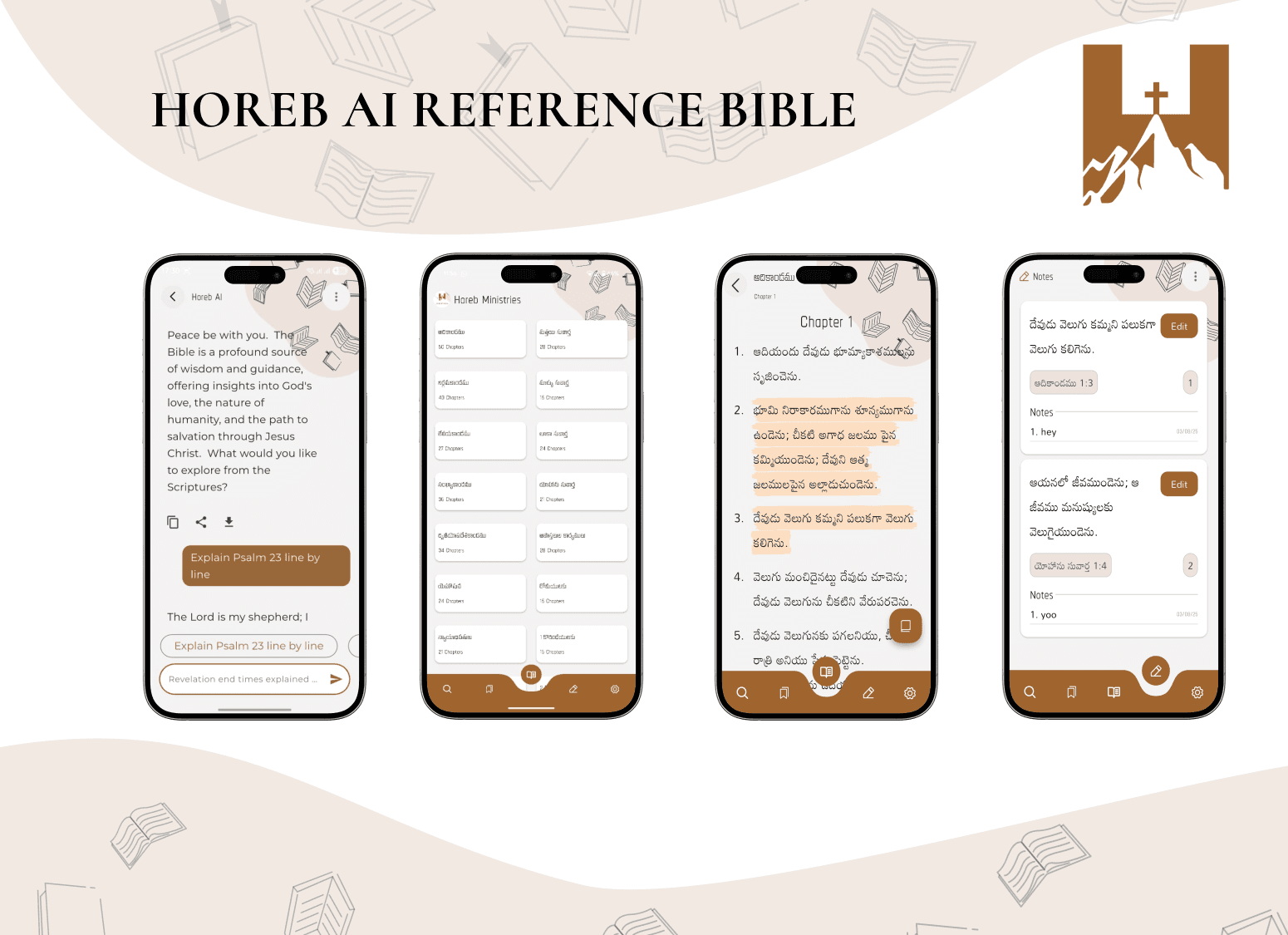
A South Indian language Bible platform with 1M+ readers wanted AI in the app itself. We recommended Horeb AI — a Vertex AI assistant that answers on the verse the reader names, in the language they are reading, evaluated separately in each of the six.
- Client
- Horeb Reference Bible
- Readers
- 1M+, six languages
- Build
- Vertex AI via Firebase
- Service areas
- Five of six
The result — scored separately in each language it serves
- Increase in subscriptions
- 4x
- Languages answered in
- 6
- Readers reached
- 1M+
01 — Brief
The problem
The client runs a South Indian language Bible platform with more than a million readers, built around one promise: get a person to the passage they are looking for with as little friction as possible — reading, search, cross-references, a topical index, a dictionary. The client asked us to add AI to it.
The obvious build
A chatbot beside the app, answering about the Bible in general.
What we recommended
An assistant inside the reader, answering on the exact verse they name, in the language they are already reading.
02 — Constraint
Why the obvious path doesn’t work here
Put a general chat model behind a text box and let readers ask it about the Bible, and it fails on this platform at three separate points — each of them in front of a reader who trusts the app.
Failure 1
GroundingA general model does not know which Bible the reader is holding.
Ask one for a verse and it recites whichever English translation it absorbed most of during training. Horeb’s readers are on the platform’s own South Indian text, on screen, right now. An answer that is defensible in the abstract but does not match the words in front of them does not read as a model limitation — it reads as the app being wrong about its own scripture.
Failure 2
LanguageThe languages this platform serves are the ones models are weakest in.
Frontier models are trained overwhelmingly on English. Telugu, Tamil, Kannada and Malayalam are thin in that data, book names transliterate several different ways, and a model that answers cleanly in English does not fail loudly in a South Indian language — it degrades quietly, into stiff, faintly wrong phrasing that only a native reader catches. “Answers in six languages” is six separate quality problems wearing one feature’s name.
Failure 3
InventionNothing in a plain chat wrapper stops it from inventing scripture.
Asked for a reference that does not exist, or for a passage it has only partially memorised, a model produces one anyway — correctly formatted, confidently worded, indistinguishable from the real verse. On a platform a million people open to read scripture, a fabricated verse is not a rough edge to be smoothed later; it is the one failure the product cannot absorb.
03 — Recommendation
Our solution
Build vs buy
No packaged assistant can be pointed at the platform’s own translations and made to answer from them, and the multilingual quality bar here is a property of how the system is evaluated, not of which model is bought. The call was to build.
The loop, end to end
AI Strategy & Roadmap
Put the assistant inside the reader rather than beside it, and make the verse reference the unit it works on. When a reader gives a reference, that reference is resolved against the platform’s own text first, and the model reasons over the verse the reader is actually looking at instead of the one it half-remembers. Scoped from the start to scripture and the platform’s own content, so the boundary of what it will answer is a design decision rather than something discovered in production.
AI Stack
Vertex AI reached through the app’s existing Firebase services, rather than a new backend or a model key shipped inside the binary. The platform already runs Firebase for auth, config, messaging and crash reporting, so the assistant rides infrastructure the team already operates and already knows how to debug. The local scripture store stays the source of the verse text; the model supplies the explanation around it.
AI Governance
Every answer carries the reference it was drawn from, so a reader can check it against the passage without leaving the screen, and the assistant is scoped to decline what its scripture does not cover rather than reaching for general knowledge to fill the gap. Language quality is reviewed per language by someone who reads it, not signed off once in English and assumed to hold across the other five.
AI Evaluation
Score the assistant separately in each language it serves. A single aggregate pass rate hides exactly the failure this platform cannot afford — strong English numbers carrying five weaker languages along behind them. The per-language sets built for that stay on as the regression suite for every model change after.
AI Security
App Check on every call, so the model endpoint answers the real app and not anything else pointed at it — an open endpoint attached to a million-reader app is a billable surface for whoever finds it. No keys in the client, and no user content leaving the paths the platform already controls.
More case studies
Agentic Financial Research
97% of answers traceable to the filing they came from, up from 63%
Atlas — dense filings turned into direct answers, each carrying the passage it was read off.
Multi-Language AI Translation
100k+ Bible verses translated across five languages using AI
Yahuah Bible Platform — word-for-word Hebrew and Greek text alongside translations for 50K+ readers.